
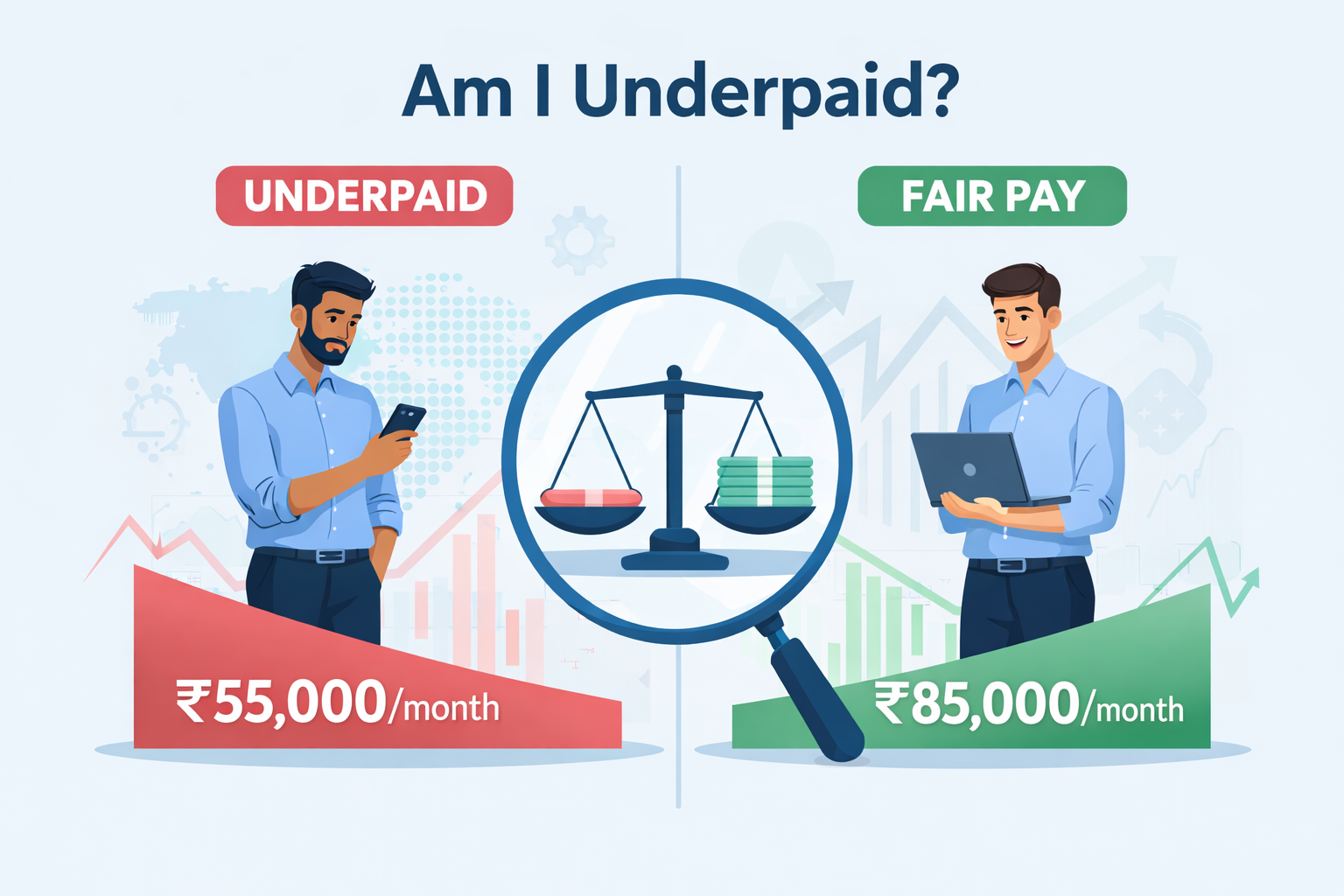
I spent years unsure if my salary was fair until I compared it with real market data. This is the story of how I discovered I was underpaid—and why I built a simple tool to help others find clarity.
Am I Underpaid? How I Built a Simple Way to Find Out
A few years ago, I found myself asking a question that almost every working professional asks at some point: “Am I underpaid?” Not out of greed — but out of confusion.
I was delivering consistently, taking on more responsibility, mentoring juniors, and still my salary barely moved. Friends switching jobs were suddenly earning 20–30% more. That’s when I realized the problem wasn’t just salary — it was lack of clarity.
Why Most People Don’t Know They’re Underpaid
In my experience as a software engineer, most people rely on:
- Office gossip
- Random salary blogs
- Outdated salary aggregation data
- One-off conversations with friends
None of these give a complete picture. Salary depends on multiple factors — role, experience, skills, company size, location, and even how long you've stayed in the same role.
The Moment It Clicked
When I compared my profile with recent job switchers in similar roles, the pattern was obvious: loyal employees tend to lag behind market pay. Not because they’re worse — but because internal increments rarely match market jumps.
That insight pushed me to build something simple — a tool that answers one question clearly:
Are you underpaid, fairly paid, or overpaid for your profile?
How FairPayCheck Works (Without Guesswork)
FairPayCheck doesn’t ask for your name, email, or employer. It looks at factors that actually affect compensation:
- Your role and industry
- Years of experience
- Key skills you use daily
- Company size
- Country and location
If you provide your current salary, the accuracy improves significantly. If you don’t — you still get a strong directional answer.
Real Examples I’ve Seen
Example 1: Software Engineer (India)
5 years experience, strong backend skills, mid-sized company.
Market range: ₹18–22 LPA.
Actual salary: ₹13 LPA.
Result: Underpaid — not due to performance, but stagnation.
Example 2: Data Analyst (Germany)
3 years experience, SQL + Python, large company.
Market range: €65k–72k.
Actual salary: €68k.
Result: Fairly paid.
Common Mistakes People Make When Evaluating Pay
- Comparing salary without adjusting for location
- Ignoring company size and funding stage
- Assuming loyalty is automatically rewarded
- Not tracking market changes annually
I made several of these mistakes myself. That’s why FairPayCheck emphasizes explanation — not just numbers.
What to Do If You’re Underpaid
Being underpaid doesn’t automatically mean quitting. In many cases, it means:
- Having a data-backed conversation
- Understanding your leverage
- Knowing your realistic market range
And sometimes, yes — it means preparing for a switch. But at least the decision is informed.
Why This Tool Is Anonymous
Salary is sensitive. People hesitate to explore it honestly if they feel tracked. That’s why FairPayCheck doesn’t store personal data or require login. Everything runs client-side.
Try It Yourself
If you’ve ever wondered whether you’re being paid fairly, you don’t need guesses or assumptions. You need context.
👉 Check your pay fairness on FairPayCheck
This article reflects my personal experience building salary analysis tools. Results are estimates and should be used as one input — not financial or career advice.
Want to check if you're being paid fairly?
Try FairPayCheck →This article is for educational and informational purposes only.